
These are the 5 personal values I live by
How about you?

I talk a lot about values—how they guide our choices, help us live with intention, and shape the way we move through the world.
So I thought it might be helpful to share a little more of my own story: how I identified mine, what they mean to me, and why they’ve become such an important part of how I live.
There are values many of us naturally connect with—things like love, honesty, kindness, and integrity.
I care deeply about those too.
But what’s been most transformative for me is getting clear on the values that feel deeply personal—the ones that shape how I spend my time, make decisions, and navigate life in a way that feels aligned.
Just to highlight upfront—these are my values.
They’re not a checklist or something to aspire to. What matters is figuring out what feels true for you. We all value different things, and that’s not only okay—it’s the whole point.
I hope this gives you a little inspiration to explore your own.
My Life Before I Knew My Values
There was a time in my life when, on paper, everything looked fine.
I had a full-time job, a long-term relationship, and a lovely house in the countryside.
From the outside, it probably seemed like I had things figured out.
But the truth is, I felt completely lost.
After finishing university, I drifted into a retail management role. It wasn’t what I’d pictured for myself—not even close to the creative path I’d once dreamed of—but it was steady and it paid the bills, so I stuck with it. I kept my head down, worked hard, and slowly built a version of adulthood that looked ‘right’ by most standards.
Looking back, I can see that I had no real sense of what mattered to me.
I hadn’t taken the time to figure that out. My choices were shaped by expectations: what I thought I was supposed to want, what other people seemed to value, and the pressure to follow a certain path.
So I just kept going, hoping the next milestone would make things feel better.
When it didn’t, I leaned on distractions.
Junk food, mindless scrolling, binge-watching TV, shopping for things I didn’t need. It filled my days in a way that left little room for clarity. These habits were a way to avoid the discomfort I didn’t yet know how to face.
Eventually, everything came undone.
I ended my engagement, sold my house, and moved back into my old bedroom at my parents’.
It felt like everything I’d built had collapsed. For a while, I felt broken—like all I had were fragments of a life that hadn’t turned out the way I thought it would.
But in hindsight, it was the beginning of something far more honest. That season made me start questioning everything. I began reading more intentionally, exploring personal growth, and slowly piecing together a new sense of direction.
That’s when I came across the concept of values.
Identifying My Values
Figuring out my values took more time—and more honesty—than I expected.
When you’ve been living a life that isn’t fully your own, it’s surprisingly difficult to know what you truly think and feel.
For so long, I’d shaped my life around what I thought I should do—without stopping to ask what actually felt right for me. So when I finally paused to reflect, I wasn’t even sure where to begin.
I realised how much I’d been running on autopilot. Even simple things, like what I enjoyed or how I spent my time, felt unclear.
I’d gotten used to tuning out my own voice, and learning how to listen again took patience.
This process wasn’t about creating a neat, inspiring list. It was more like peeling back the layers and getting curious about the things that had always quietly mattered to me.
And slowly, some core themes began to emerge.
1. Freedom
One of the clearest threads that emerged was my need for freedom—not just physical freedom, but creative and emotional freedom too.
I’ve never wanted to feel boxed in, tied to routines or systems that don’t make sense to me.
Even as a child, I remember feeling dreadfully afraid at the idea of becoming an adult with bills and responsibilities and no real space to live.
I saw how work wore my parents down—how tired they were sometimes, how we lived for weekends and family holidays. I didn’t know many people living outside the traditional path, so I assumed that was just the way life had to be.
But deep down, I always knew I didn’t want to spend my days working on someone else’s dream or becoming a cog in a machine.
For me, freedom means having the space to choose. To change direction when something no longer feels right. It’s not about escaping responsibility—it’s about creating a life where I have the autonomy to follow my own passions and pursue what feels meaningful.
It’s the foundation that allows everything else to grow.

2. Courage
I’ve long admired people who express themselves fully and unapologetically—those who don’t shy away from being different, who challenge the rules and carve out space for their own truth.
Some of my favourite musicians embody that spirit—David Bowie, Amanda Palmer—artists who push boundaries, reinvent themselves, and refuse to play small.
That kind of fearless self-expression has always felt magnetic to me.
But my connection to courage runs deeper than that. It matters so much to me because, for much of my life, fear has been a quiet undercurrent.
As a child, I struggled with anxiety and OCD.
My thoughts often felt overwhelming, intrusive, and out of my control. I became skilled at managing, hiding, overthinking—doing whatever I could to keep things feeling safe and predictable.
I didn’t have the language for it back then, but I knew what it meant to live in constant negotiation with fear.
That’s why courage feels so personal to me.
It’s wonderful when it’s loud and expressive, but just as important is the quiet, constant courage it takes to live in a way that’s true to me—to manage my emotions, push past discomfort, and stay grounded in authenticity and integrity, even when it feels hard or scary.

3. Creativity
Some of my clearest memories from childhood are those moments of being completely absorbed in something I was making—whether it was writing, drawing, or simply creating.
That flow state, where time disappears and everything feels aligned, is where I do my best work. And it’s still the space where I feel most like myself.
Looking back, this value showed up early.
At school, I was always drawn to English and Art—subjects that gave me the freedom to explore meaning, play with metaphors, and express myself in ways that felt exciting and true. I loved getting lost in stories, drawing connections, and finding beauty in how something was said or shown.
It’s what led me to study for a master’s degree in Creative Writing. And even later, when I found myself working in retail, I naturally gravitated toward visual merchandising—something I genuinely enjoyed and felt creatively connected to.
It also makes complete sense when I consider my personality type (INTJ 5w4 👋).
As someone who’s always been introspective and meaning-driven, creativity isn’t just an interest—it’s how I process the world, explore ideas, and give form to what’s going on internally.
It’s the thread that keeps me feeling most alive.

4. Learning
I’ve always been someone who wants to understand the deeper why.
I’m endlessly curious—constantly reading, questioning, trying to make sense of how things work beneath the surface. Learning new things means challenging my assumptions, expanding my perspective, and staying open to change.
That open-mindedness is something I hold closely. I’ve never been comfortable with rigid thinking or ingrained ways of being.
Stubbornness—especially for its own sake—has always unsettled me. I value the ability to stay curious, to ask better questions, and to allow myself to shift my beliefs (and even my identity) when I learn something new.
This mindset has shaped some of the biggest changes in my life.
It’s what helped me go vegan, stop drinking alcohol, start a blog, and rethink my relationship with money, to name just a few. Each of those shifts came from being willing to look at things differently—to release old narratives and evolve, even when it felt uncomfortable.
Learning, for me, isn’t really about facts—it’s about letting new insights influence how I live, and who I’m becoming.
It’s also deeply humbling. No matter how much I think I understand, there’s always room to grow.

5. Health
For a long time, I said I cared about health—like most of us do.
It’s something we all know we should prioritise. But in reality, it often gets pushed to the bottom of the list. We pay it lip service while focusing on everything else, promising ourselves we’ll get to it later.
That was true for me too—until I recognised it as one of my core values.
I began to approach the basics differently: the food I eat, how I exercise, and the importance of rest.
These days, I focus on a whole food, plant-based diet and no longer drink alcohol. I make time for regular daily movement, and I do my best to get seven to eight hours of quality sleep each night.
None of it is meant to feel extreme or rigid, and I’m not always perfect. But it’s the foundation I return to—a steady way of taking care of myself that supports the rest of my life.
Because without my health, everything else becomes harder to sustain. When I feel well—physically, mentally, emotionally—I have the energy and stability to show up fully for the things that matter.
For me, caring about my health is the very definition of self-care.
Not a luxury, but a responsibility.
I can’t pour into others or create anything meaningful in the world if I’m constantly depleted. I’ve realised I have to put my own oxygen mask on first.

These are the personal values that guide my life—and just having the language for them has brought so much more clarity and direction to how I live day to day.
They shape the content I create here on Intentional View, from the topics I explore to the way I write about them.
When you know what matters most to you, it becomes easier to make decisions, set boundaries around your time and energy, and recognise the right opportunities.
Your values become a kind of compass. They help you focus on what truly matters and let go of what doesn’t.
More than anything, identifying your values is a way of taking your life seriously and deciding how you want to show up in the world.
Now I’d love to know: what are your personal values? And why do they matter to you?
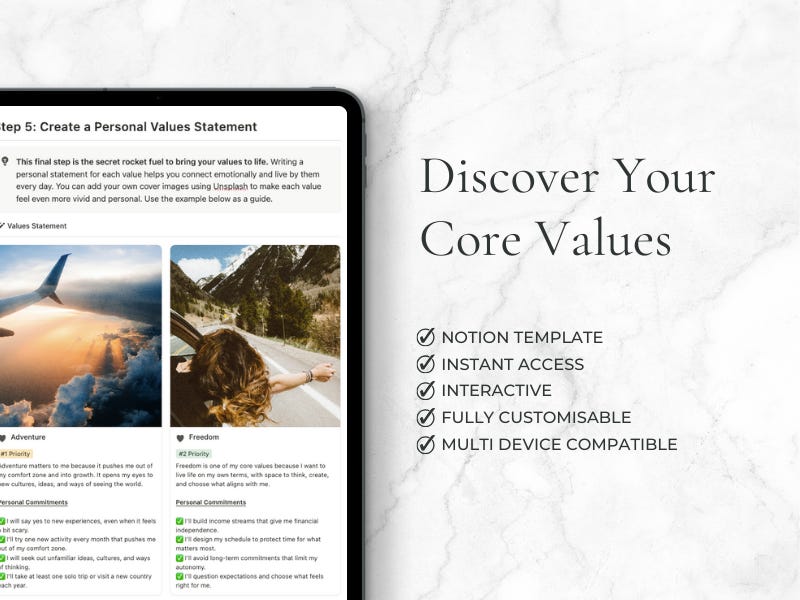
If you’re still figuring that out, I’ve created a Core Values Workbook to help you get started. It walks you through five simple steps to identify your values and why they’re important to you—something you can return to whenever life feels off track.
It’s the kind of resource I wish I’d had when I began my own intentional living journey.
And to take things a step further, check out my Intentional Life OS—a Notion system designed to help you turn your vision and values into inspired action and create a life you actually want to live.