
What Are Core Values & Why Do They Matter?

This post may contain affiliate links, which means I may earn a small commission if you make a purchase (at no extra cost to you). Read more.
Defining my core values has been one of the most transformative things I’ve done in my life. It’s helped me clarify what truly matters, make better decisions, and live in alignment with the person I want to be.
That said, I totally get it if you’re feeling a bit sceptical. The concept of ‘core values’ can feel a little abstract or overly idealistic at first glance. But when you take the time to reflect on your values, the impact can be profound.
So, what exactly are core values, and why should you care about defining them? That’s what we’ll be unpacking today.
What Are Core Values?
Core values are the fundamental principles and beliefs that guide your decisions, actions, and the way you live your life. Think of them as your internal compass—they keep you grounded and aligned with what truly matters to you.
Here are some key aspects of core values:
They reflect what’s most important to you: Core values are deeply personal and unique to each individual.
They influence your decisions: Whether consciously or unconsciously, your values shape the choices you make daily.
They provide clarity: When you know your core values, it becomes easier to set boundaries, prioritise tasks, and stay true to yourself.
They evolve over time: Your values can shift as you grow, experience life changes, or gain new perspectives.
Identifying your core values allows you to live with greater intention and authenticity, creating a life that feels meaningful and fulfilling.
Some Examples of Core Values:
Freedom
Creativity
Family
Adventure
Courage
Health
Honesty
Curiosity
Connection
Sustainability
Compassion
Growth
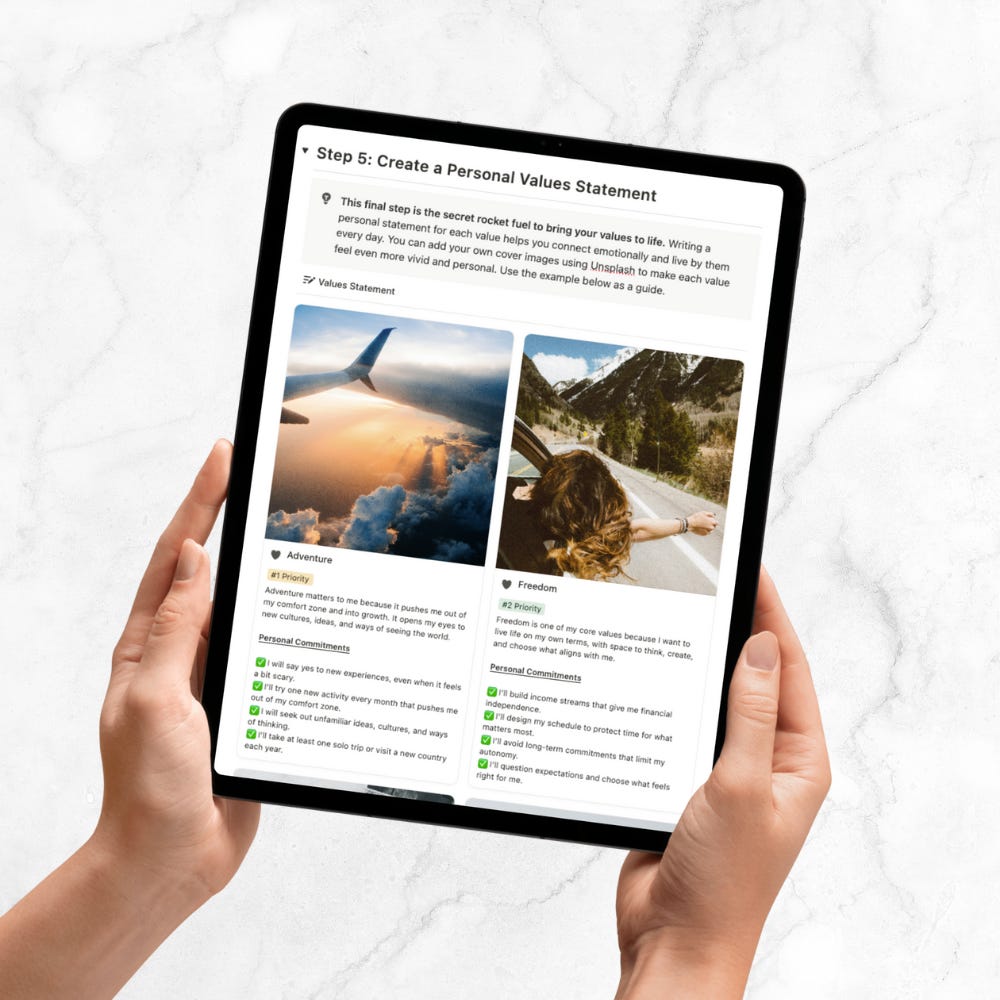
Your list of core values will be unique to you, but these examples can serve as inspiration to get started. If you’d like to explore this further, my Core Values Workbook includes a master list of over 100 values and a guided process to help you get started.
5 Steps to Discover Your Core Values
Get your FREE Personal Values Notion Workbook plus tips on intentional living—and start designing a life you love.
6 Reasons Why Personal Values Are So Important
1. Reduces Decision Fatigue
Every day, you face a barrage of decisions—some minor, others more significant.
Hit snooze or wake up with your alarm?
Go out with friends or stay home to recharge?
Cook dinner or order takeout?
While there’s no universally “right” or “wrong” answer to these questions, your choices should align with what matters most to you. That’s where personal values come in.
When you identify your core values, decision-making becomes significantly easier. Instead of feeling overwhelmed or second-guessing yourself, your values act as a filter to guide you towards choices that reflect your priorities. This not only simplifies your life but also ensures you’re spending your time and energy on what truly matters.
Even big, life-altering decisions—ones that may have once kept you up at night—can be navigated with greater clarity and confidence when anchored by your values.
2. External Validation Becomes Less Important
Seeking constant approval from others can be exhausting—and damaging. It often leads to chronic people-pleasing, shrinking your potential, and feeling disconnected from your true self.
Approval-seeking might show up in various ways, such as:
Over-analyzing your appearance.
Relying too much on the opinion of authority figures.
Sacrificing your own needs to make others happy.
The truth is, everyone has different values, and you simply can’t please everyone. When you focus on defining and living by your core values, you gain a sense of internal alignment that reduces the need for external validation.
Life is short, so lean into what makes your heart sing. With clear values, you can develop stronger self-trust and look inward for approval, freeing yourself from constantly chasing others’ expectations.
3. Keeps You Motivated When Faced with Challenges
One of the biggest shifts I’ve experienced since defining my core values is how I handle adversity. Situations that once left me feeling defeated or stuck now feel far more manageable.
This doesn’t mean challenges magically disappear. But when they arise, I can lean on my values to reflect, re-evaluate, and respond from a place of personal strength.
That’s the beauty of core values: while life can take away your job, your possessions, or even loved ones, your values remain untouchable. They’re a grounding force in times of uncertainty.
Think of leaders like Martin Luther King Jr., whose deeply held values guided him through relentless adversity and unwaveringly shaped his mission for justice and equality. His life is a powerful testament to the strength that comes from aligning your actions with your core beliefs. One of my favourite quotes by Viktor Frankl beautifully captures this idea:
Viktor Frankl
“He who has a why to live for can bear almost any how.”
When you know your why, challenges don’t seem so insurmountable. Instead, they become opportunities to realign with what matters most.
4. Helps to Set Healthy Boundaries
Boundaries are essential for honouring your non-negotiables, but they’re much harder to establish if you haven’t first clarified your values.
Let’s say creativity is one of your core values. You might decide to dedicate an hour every morning to creative work. If a friend calls during this time, having clear boundaries allows you to respond in alignment with your values: “I’m busy right now, but I can call you back in a couple of hours if that works for you?”
Without defined values, you might feel conflicted or pressured to abandon your plans, which could lead to resentment or frustration later on.
Setting boundaries isn’t selfish—it’s self-care. It ensures you’re protecting your time and energy so you can show up fully for both yourself and others.
Oprah Winfrey
“You can’t pour from an empty cup. Take care of yourself first.”
5. Promotes Independent Thinking
Living by your values encourages you to step outside your comfort zone and engage more actively with the world around you. True growth comes from contribution, not complacency.
It’s easy to internalise the values you were raised with, but history has shown us that societal norms aren’t always right—slavery was once accepted, and women were once deemed too unintelligent to vote. Every generation faces its own challenges in the fight for equality, love, and freedom.
By defining and living by your personal values, you empower yourself to think independently, question outdated beliefs, and contribute to positive change—not just in your own life, but in society as a whole.
6. You Become Less Outcome-Oriented
Pinning all your happiness on achieving specific outcomes can make you feel trapped and powerless. Life is unpredictable, and clinging to rigid goals often leads to frustration when things don’t go as planned. Understanding your core values helps you shift your focus from external achievements to internal fulfilment, allowing you to maintain your peace of mind—regardless of the outcome.
By prioritising your values, you open yourself up to opportunities you might not have considered before. For example, if creativity is one of your core values, you might find more fulfilment pursuing a freelance role or starting a side project, rather than following a traditional corporate career path. Similarly, if connection is important to you, you might thrive in a collaborative environment like a nonprofit or community-focused organisation—even if it doesn’t come with the prestigious title you once thought you needed.
Living by your values keeps you grounded and flexible, guiding you toward roles, relationships, and achievements that align more fully with your authentic self.
Core Values FAQs
What if I’m not living by my personal values?
First, recognise that you may already be living in alignment with some values, which is a great start! However, it’s also common to discover areas where your actions contradict your core beliefs.
For example, I discovered that while I valued ‘Courage,’ fear often held me back and kept me playing small. Recognising this helped me consciously work toward living more courageously—like starting Intentional View, a step I once believed was only for people who were far more confident or experienced than me!
If you notice misalignment, don’t despair. Use this awareness as an opportunity to realign and make meaningful changes.
How do I course-correct If I’m out of alignment with my values?
Start by identifying where the misalignment exists. Reflect on the gaps between your current actions and the person you want to be.
Ask yourself questions like:
What values do I admire in others, and how can I emulate them?
How can I integrate these values into my daily habits and decisions?
Even small changes can create significant momentum over time. It’s about having self-awareness and taking intentional steps to bring your life into alignment with your values. I’ve shared some actionable steps here.
Are your values fixed forever, or can they change?
Values can evolve over time, and that’s perfectly natural. While some may remain constant, others shift with life stages or experiences.
For instance, you might prioritise ‘Freedom’ in your 20s, focusing on travel and independence. But as you enter your 30s, ‘Family’ could take a front seat as your circumstances and priorities change.
Revisit your values every few years, especially during major life transitions. Use my core values workbook to identify any shifts and determine how to move forward in alignment with your evolving priorities.