
The hidden value system that’s making you miserable
And how to change it...

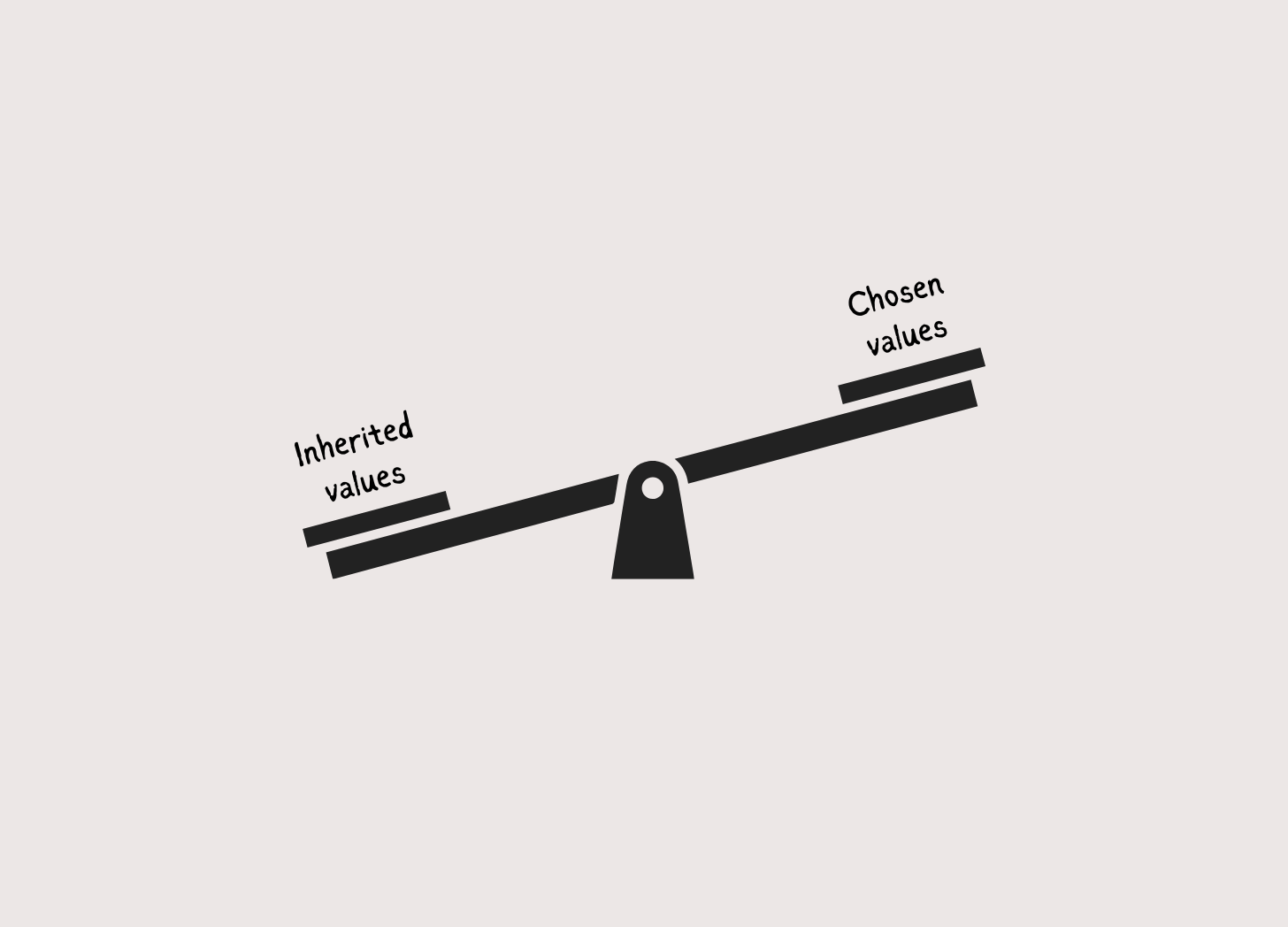
I used to think I knew my values.
I told myself I was pursuing what mattered, that my choices were my own.
But over time, I started noticing a pattern: I was constantly running after things that felt important, yet never seemed to bring the satisfaction I expected.
You might feel the same. You chase the things you were led to value, believing they define who you are.
And at first, they do feel meaningful. They feel natural. They feel like “the right way” to live.
But slowly, almost imperceptibly, they start to control your decisions, your time, and even how you see yourself.
You keep going after them because they’re familiar, because everyone else seems to be chasing them too, and because they feel like a shortcut to fulfilment.
The problem is that no matter how appealing they seem, they rarely lead to lasting happiness. They promise satisfaction but deliver only more striving, more comparison, and more restlessness.
That’s why it’s worth pausing: to shine a light on the hidden systems shaping your choices, to see where you’ve been following a script you didn’t write, and to begin reclaiming your time, energy, and life—so you can focus on what truly matters to you.
The invisible rules shaping your life
If you never stop to examine what you value—and why—you end up living inside a value system you didn’t consciously choose.
One that quietly directs your behaviour, your goals, and even how you measure your worth.
Most of us don’t question it because it feels obvious, or just “how life works.” But many of these values are inherited from a culture driven by consumption and profit—one that rarely has your happiness or inner peace at heart.
You might sense this instinctively: that despite doing everything you’re “supposed” to do, something still feels missing.
And if the beliefs underpinning your life are unhelpful—or worse, actively working against you—what chance do you really have at feeling fulfilled?
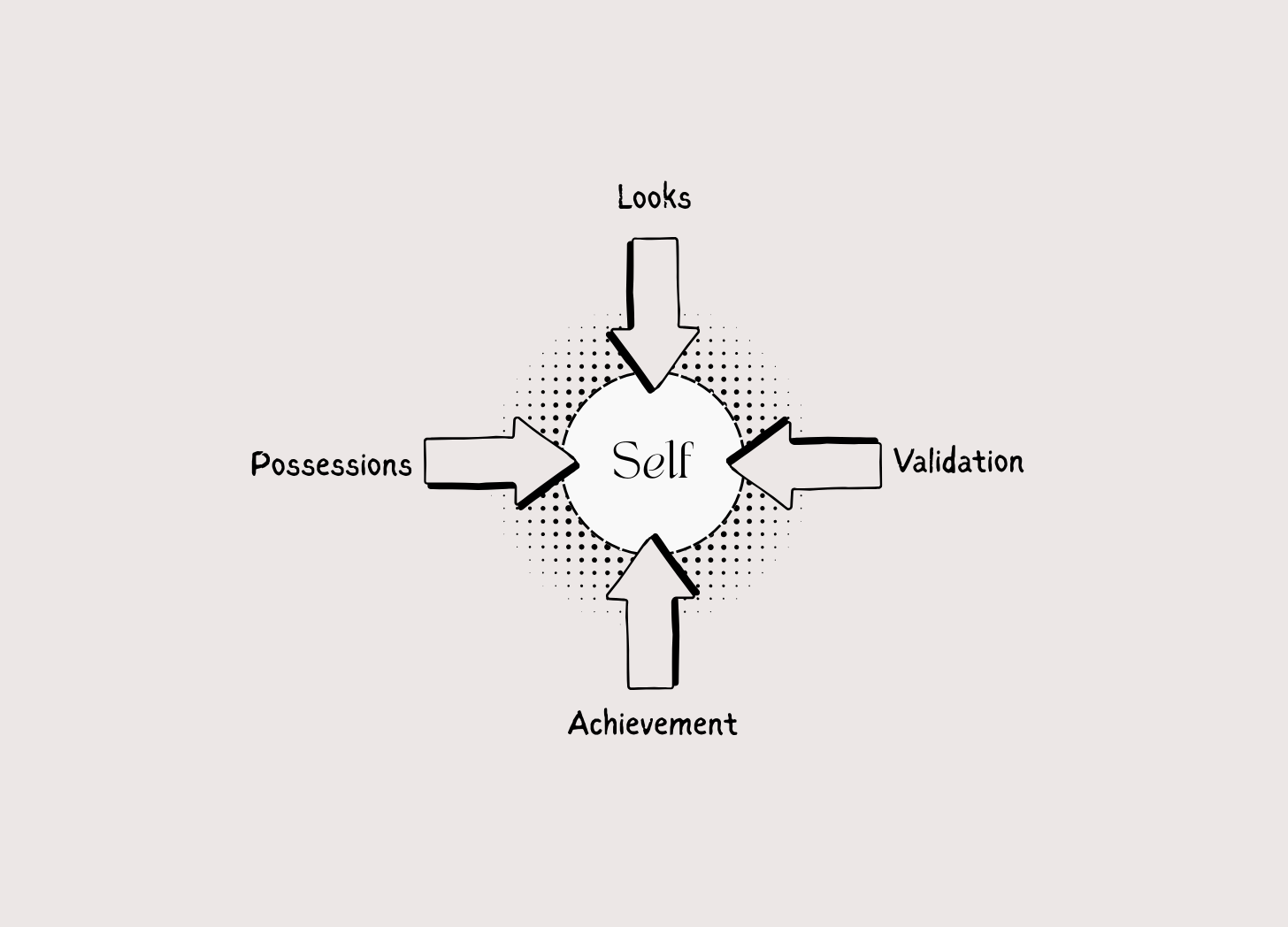
Beneath so many of our choices sit quiet, unspoken rules:
I have to look a certain way.
I have to achieve constantly.
I have to be admired, successful, desirable.
The unspoken conclusion is almost always the same: then I’ll be worthy, lovable, enough.
If you’d asked me a few years ago, I probably wouldn’t have liked to admit that I valued these things. They feel… shallow.
And the problem is, that’s exactly what they are.
Sometimes it helps to just acknowledge it out loud, without judging yourself. The more honest you are about what’s actually running your attention and energy, the more power you have to change it.
These narratives don’t usually announce themselves—they seep in slowly, through media, education, social norms, and comparison. And unless we bring them into the light, they continue to shape our lives from the background.
I want to break each one down in more detail—and explain why it’s worth questioning whether they deserve so much power over us.
1. Looks
It might seem obvious that how we look shouldn’t be the be-all and end-all of our lives.
And yet here we are, living in a culture completely obsessed with physical appearance.
For women especially, society constantly tries to convince us that there’s something “wrong” with our bodies, faces, or hair—something that needs fixing or improving.
Perfection is positioned as the gateway to being lovable or accepted.
Reality TV, social media, and advertising only reinforce this, normalising lives that revolve around appearance, sex appeal, and surface-level beauty, leaving little room for anything else.
Feminism has highlighted how women are often forced to exist as both subject and object. That duality creates a detachment from our own bodies—we’re always aware of being watched, rather than fully inhabiting our skin.
I know I’ve felt this myself—constantly conscious of how I appear in photos, hyper-aware of how others see me, instead of fully experiencing life in my own body.
If enough of our energy is wrapped up in worrying about appearance, dieting, or perfection, there’s little mental space left for deeper pursuits—creating, contributing real value, or thinking about the legacy we want to leave.
Industries profit from this distraction, and cultural norms reinforce it. It keeps us small, anxious, and easy to sell to.
It’s fascinating to me to recall that up until my early teens, I never once thought about my appearance. I was too wrapped up in my passions—art, writing, and reading—to care about something as inconsequential as how I looked.
That alone is a reminder: our obsession with looks isn’t innate—it’s conditioned.
I’d love for us to start normalising the idea that the least interesting thing about us is our appearance. While it can easily consume our attention, it isn’t a core value.
And let’s not forget the irony: we live in bodies that are constantly aging! The pursuit of youth is absurd when you stop to think about it. If the one certainty in life is that we will grow old, placing value on looking younger can only lead to insecurity and self-loathing.
We deserve better values than ones that teach us to despise ourselves.
2. Validation
One of the sneakiest values we pick up from society is the need for approval.
From a young age, we’re conditioned to be “good girls” or “good boys,” to please, to fit in, to avoid rocking the boat. Slowly, we learn to place our sense of self in the hands of everyone around us—teachers, friends, colleagues, partners, even strangers online.
Social media only amplifies this. Likes, follows, shares, and comments have become small but constant measures of how we’re doing in the world. We post snippets of our lives, hoping to be admired or validated, and judge ourselves by the reactions we get.
I know I’ve felt this myself—carefully curating the “right” version of myself, worried about whether I’m coming across as interesting, competent, or likable.
It can feel almost automatic, like a reflex, but the problem is that it quietly gives control of your life to others.
Trying to be liked by everyone is impossible. Our own biases, different ways of viewing the world, and even associations people carry in their minds mean 100% approval will never happen.
So the only person you can consistently show up for is yourself.
When your sense of worth depends on others, it doesn’t just affect your confidence—it shapes your choices.
You start molding your opinions, interests, and even your lifestyle based on what you think others will admire. You become like a plastic bag in the wind, drifting to fit whoever you encounter, rather than a fully-formed person with your own foundation.
And paradoxically, this often earns you less respect and connection, not more.
Approval can feel good, and it’s natural to crave it to some extent—but when it becomes the measure of your worth, it quietly controls your life, keeping you from focusing on what truly matters.
The freedom comes when you start turning inward: asking yourself what you actually care about, what excites you, what feels meaningful. By standing firm in your own likes, dislikes, and passions, no matter how others might judge you, you begin to reclaim your life.

3. Achievement
It often feels like there’s no choice but to follow a set path: go to university, get good grades, land a stable job, and climb the career ladder.
Society tells us this is the only route to success, respect, and security. From parents to teachers to bosses, the message is consistent: work harder, achieve more, and measure your worth by your productivity.
I know I’ve felt this pressure myself—the sense that if I wasn’t studying, working, or “building my future,” I was failing, or even worse, that I was unlovable.
I grew up as an A* student in a family that encouraged excellence and praised achievement above almost everything else. Success became the yardstick I used to measure myself, and even small setbacks carried a weight I didn’t always know how to shake off.
The transition from school to the working world can feel like stepping onto another treadmill. Grades turn into performance reviews, exams into deadlines, and comparisons continue in new ways—but the pressure to prove yourself never really goes away.
I’ve also realised I really struggle to do nothing. Even when I’m not “working” in the traditional sense, there’s this constant internal pressure to optimise every second.
I never used to think like this as a child; downtime was just downtime, and that was enough.
I want to be clear: I’m not saying we should never strive, create, or challenge ourselves. In fact, I think humans are at their best when we’re immersed in meaningful, creative challenges at the edge of our comfort zone.
There’s a huge difference, though, between doing work you genuinely love and hustling to prove something about your worth.
In other words, chasing achievement for the sake of it never leads to fulfilment.
If your energy is spent climbing a ladder that’s leaning against the wrong wall, you’ll miss what actually makes life rich: curiosity, creativity, meaningful relationships, and discovering what you enjoy doing for its own sake.
External markers of success—titles, income, recognition—can quietly take over, shaping your time, your choices, and even how you feel about yourself.
Your career doesn’t define you, and it doesn’t define the richness of your life or the value you bring to the world.
Don’t make the mistake of sacrificing your health, friendships, and passions to chase a standard that wasn’t even yours to begin with.
4. Possessions
I used to think that happiness came with stuff.
A bigger house, the latest gadgets, designer clothes—I chased them all. At the time, it felt like they were proof that I was “doing life right,” proof that I had arrived.
I remember moving to my dream house in the countryside and thinking, this will solve everything. But it didn’t. None of the old worries disappeared—they just came with bigger bills.
From the outside, it looked like I had it all. From the inside, I felt… the same, if not worse.
I realise now that I bought stuff more for what it signaled than for what it actually gave me. New shoes or a shiny phone would feel exciting for a moment, but that feeling always wore off quickly.
The sad truth is: the only people who genuinely benefited were the ones trying to sell me stuff.
Retailers and advertisers are masters at this—they know how to push our buttons with limited-time offers, scarcity tactics, and urgency. But they’re inviting us to fill a void that no amount of stuff can ever satisfy.
Looking back, I see a pattern: every time I felt a strong urge to buy something, it wasn’t really about the item. It was about a gap inside me—loneliness, boredom, self-doubt, or a need to feel worthy.
Stuff was a placeholder for something deeper I wasn’t attending to.
The lesson I’ve learned—and it’s one I keep reminding myself—is surprisingly simple: less is more.
When you feel that pull to buy, pause. Ask yourself, what am I really trying to achieve here?
Fulfillment isn’t about accumulating more. It’s about looking inward, noticing what you actually need, and learning to meet it without relying on objects to do the work for you.
Owning less doesn’t mean living without joy. It means making space for the things that actually matter, and the work of discovering who you really are.
When you shift the focus inward, you start to see how little of your happiness was ever really tied to what you owned.

Whether it’s how we look, how we’re seen, what we achieve, or what we own, each of these unspoken pressures quietly strips away the joy that comes from simply being alive.
Sometimes, the only solution that springs to mind is retreating to a little log cabin in the woods—disconnecting entirely from the world and its endless expectations.
But I know that’s not the real answer.
The shift we need is both far easier and far more radical: awareness.
Noticing the invisible rules shaping our choices, questioning them, and starting to reclaim the parts of life that feel genuinely meaningful.
Whenever you feel overwhelmed by these pressures, pause and ask yourself: what is this really about? Often, it’s a value that isn’t yours. Instead of measuring yourself by it, judge yourself by your own standards.
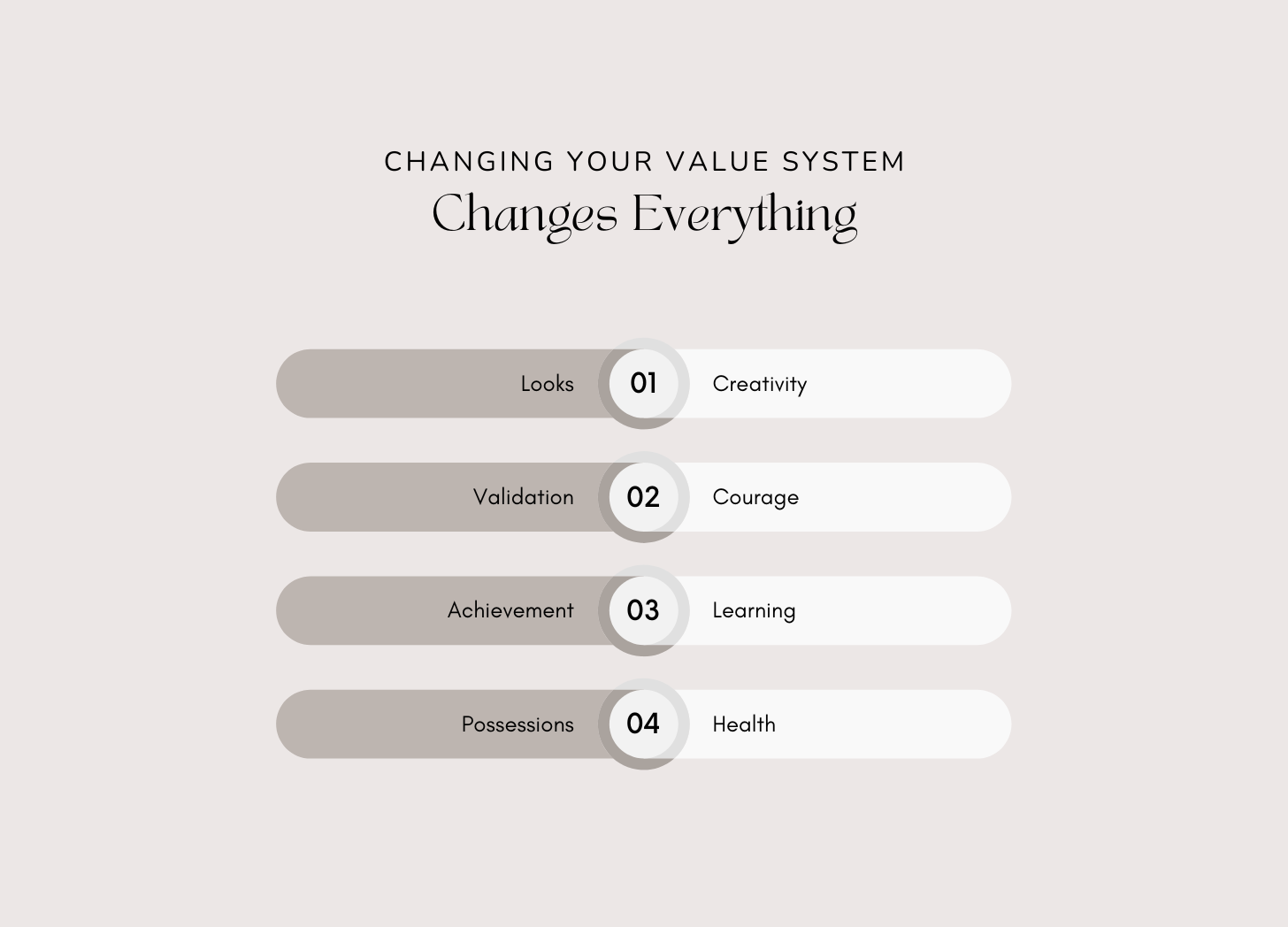
Imagine taking those pressures—looks, validation, achievement, and possessions—and exchanging them for values that truly matter to you. For me, it was creativity, courage, learning, and health. The moment I made that shift, I felt like I could finally breathe again. Life became richer, freer, and more aligned with who I really am.
I’m not saying this is easy, or that it happens overnight. Rewiring your subconscious programming takes time—and it takes courage to bear the torch when the world around you rewards conformity, not curiosity.
It’s counter-cultural to value depth over surface-level appearances, presence over performance, and self-knowledge over endless comparison.
But every small step of awareness creates space for a different kind of life—one guided less by outside expectations and more by what you actually care about.
And while it may feel lonely at times, it’s quietly revolutionary. Because the more of us who notice these patterns—and choose differently—the more room there is for joy, connection, and fulfilment that comes from living intentionally, not from chasing what we’ve been told we should want.
Take the time to discover your own unique set of personal values. Let them guide you. They are the compass that will point you toward a life that feels truly yours—built from what you care about, not what the world demands.

Very true. I like this article. 💓💯
This realy struck a chord with me. The bit about achievement hit especially hard - I definately caught myself measuring my worth by productivity even during downtime. Its wild how much of what we chase (looks, validation, stuff) is just conditioned rather than genuinely ours. I had a similer realization last year when I noticed I was buying things to fill an emotional gap rather than becuase I actually wanted them. Your framework of swapping out inherited values for chosen ones is such a helpful way to think about it.