
I decluttered 90% of my possessions in 4 weeks
I already thought I was a minimalist, but then things went to a whole other level…

After living between our separate houses for a couple of years, my partner and I finally decided to properly move in together. It made complete sense—financially, emotionally, practically—but if truth be told…
I’d been putting it off.
Renting my house out had been on my list of goals for the year, but by October, I realised with a pang that it probably wasn’t going to happen. We’d done a lot—renovated the garden, painted rooms, fixed odd little issues—but somehow the project kept stalling just before the final hurdle.
On top of that, I was getting tired of friends and family asking how it was going. I hadn’t made the progress I’d promised, and every question was a little reminder that I was behind on my own plans.
I finally called a local letting agent. I wasn’t expecting much—just an initial conversation to get the ball rolling.
But within a few days, they called back: a young couple wanted to rent my house and could move within a month—without it ever even hitting the market.
It was exactly the push I needed—a real deadline I couldn’t ignore.
But moving in with my partner and merging our lives also meant figuring out what to do with all my stuff. (To be clear, I wouldn’t say I have an excessive amount by most standards—I live in a small two-bed—but I am very good at shoving things into cupboards and creating the illusion of space. And I did have a fair amount of bulky furniture.)
At first, I thought putting it all into storage would solve the problem. I could keep everything, sort it later, and deal with it on my own schedule. I even got removal quotes—£800 to pack and move it, then £150 a month thereafter to store it. It seemed like the only logical thing to do.
Until the little voice in the back of my head piped up:
Soph… you’re supposed to value minimalism and time freedom. Is tying yourself to all this stuff REALLY what you want?
The answer was immediate: No.
But that didn’t make it feel any easier…

I created the Intentional Life OS to help you get clear on what truly matters to you and build a life you love.
It’s the ultimate Notion set-up, and it’s on offer for a limited time.
Why we resist letting go
Decluttering isn’t just about things—it’s about you.
Your stuff is a reflection of everyone you’ve been and the person you imagine yourself to be—a mirror of your projected identity.
Messing with it can be surprisingly destabilising.
It’s like letting go of little pieces of yourself, one by one.
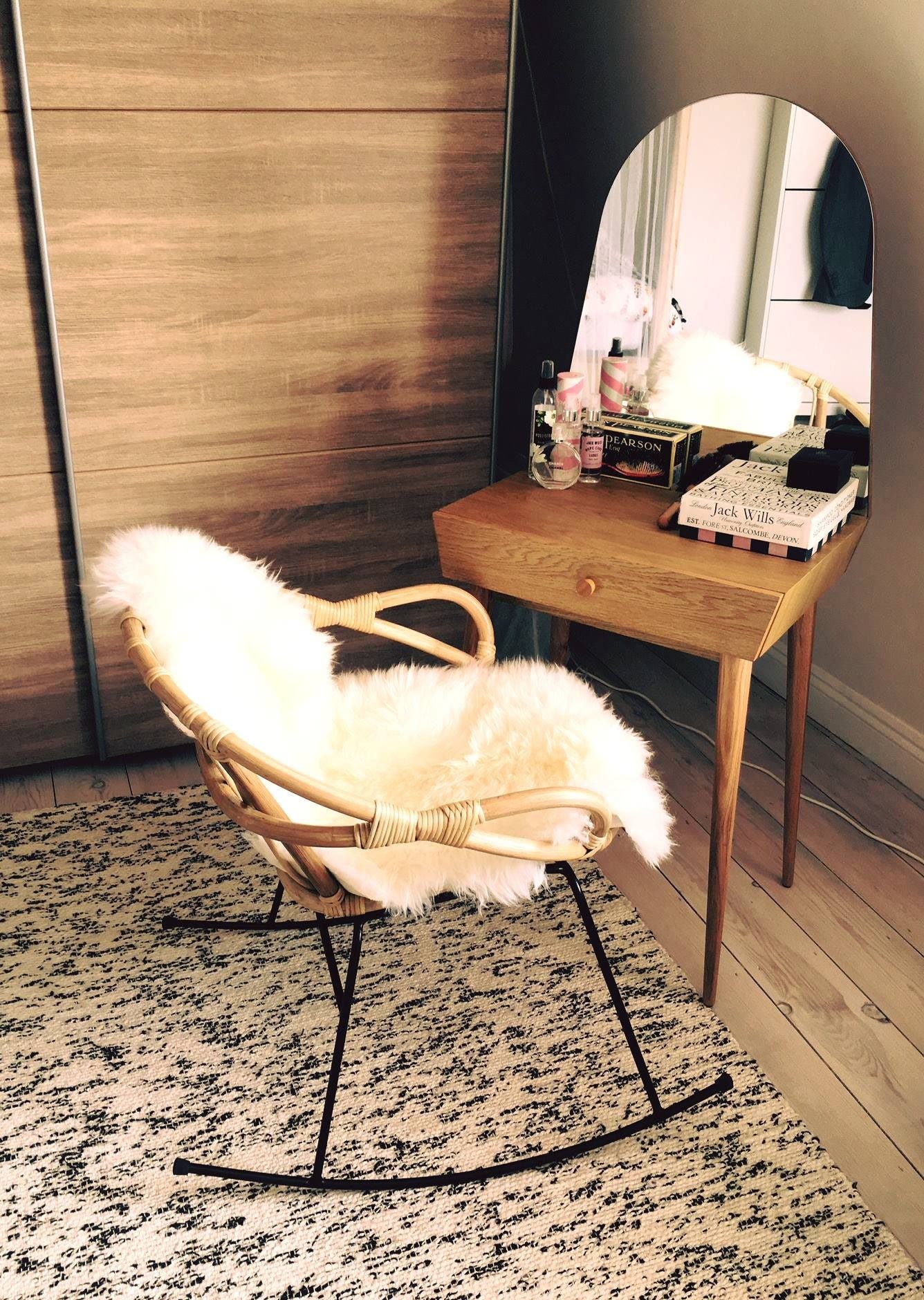
Even something as simple as my sweet vintage-style vanity table—something I’d had since my very first house—carried a weight of history I was reluctant to release.
Then there were the boxes holding past traumas: photos, cards, old letters. I found myself sitting on the living room floor, surrounded by keepsakes, weeping over anniversary cards from my ex, reopening old wounds I hadn’t touched in years.
Decluttering forced me to face all of that—my past, my identity, my attachments—without running away.
And it made one thing clear: our resistance to letting go isn’t random. It comes from patterns that are surprisingly universal:
We cling to past versions of ourselves
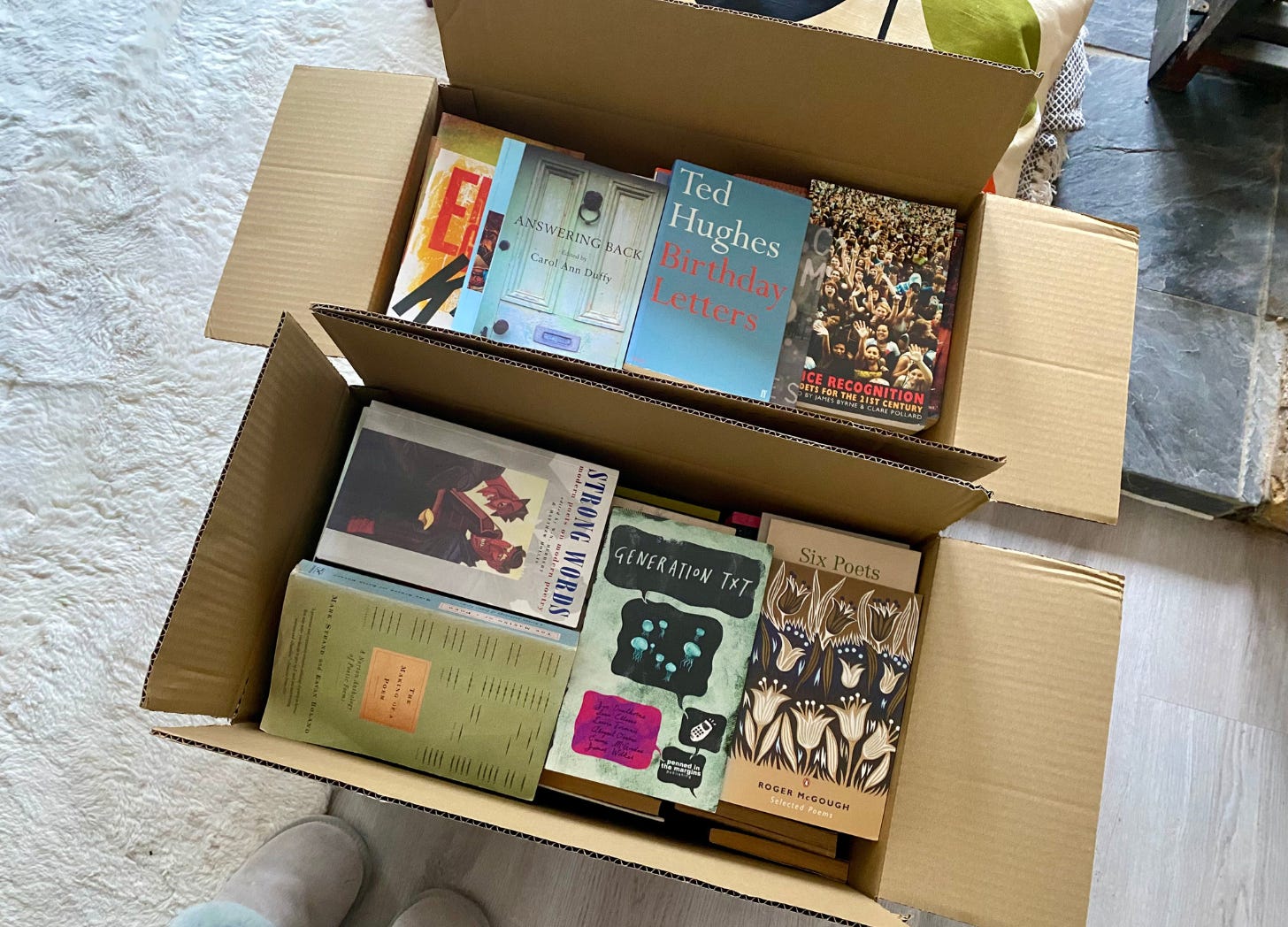
I had a 100+ book poetry collection from my university days and my Creative Writing Masters. Back then, my sole ambition in life was to become a published poet, so that collection meant everything to me.
Deciding to finally let go of it wasn’t just about freeing up space—it was about acknowledging that this part of my life had run its course. That old dream, once such a defining part of who I was, finally died with it.
It’s just one example, but it illustrates a bigger truth: our possessions often carry fragments of who we used to be. Letting go of them isn’t just tidying up—it’s accepting that certain chapters of our lives are finished, and coming to peace with that.
We cling to our fantasy selves
The fantasy version of myself makes her own fresh batch of oat milk every week and regularly entertains guests.
In reality, my plant milk maker sits forlornly at the back of a kitchen cupboard, alongside my beautiful collection of glassware—pastel wine glasses, gold-rimmed gin glasses, rainbow-tinted shot glasses… you name it.
The biggest irony of all? I don’t even drink alcohol anymore!
Letting go of these items was a blunt reminder that I am not my fantasy self. And while that can be hard to face, it’s also a relief.
There’s a certain freedom in releasing the burden of things you don’t use, in accepting who you actually are instead of who your stuff pretends you are.
We cannot deal with the guilt of sunk investments
Part of the reason we cling to stuff is money. We hate the idea of spending on something and then “losing” it, even if it’s no longer useful. It’s a weird kind of guilt—financial, but also emotional.
Take the furniture in my spare bedroom. I hadn’t had it long, but I needed to clear the room to rent out my house.
Letting it go felt like admitting defeat, like throwing money straight into the wind. And yet, keeping it for the sake of what I’d spent on it was actually costing me more—every month the property stayed empty, the “loss” from the furniture was multiplied.
At the end of the day, you just have to forgive yourself for poor purchasing decisions—or, at the very least, accept that you’ve had your use out of it and move on.
We cannot handle disappointing others
As a recovering people-pleaser, this was something I particularly struggled with.
It’s one thing to let go of things you’ve bought yourself—but when family is watching, noticing that you’re decluttering items they gifted to you, it can feel almost impossible.
I had to remind myself that all those things came from a place of love and care. Letting them go doesn’t erase that. You can acknowledge the thought, the gesture, and the joy something brought you—and still respectfully release it.
We find some sense of security in our stuff
The more we have, the more secure or stable we feel in the world. There’s something inherently scary about accepting that we can rely on ourselves, without physical possessions as a safety net.
For me, this went even deeper. My house had been my haven—a place to get back on my feet after a long-term break-up where I lost everything. It represented stability, comfort, and control. Moving in with my partner meant letting go of that physical anchor, and trusting that I could feel secure without it.
Decluttering became part of this process. Every item I let go of wasn’t just physical—it was a small act of opening my heart again, and reclaiming the ability to feel safe without holding on to everything around me.
6 things that actually helped
Throughout this process, a few things genuinely made a difference. They weren’t so much practical strategies as emotional ones—but honestly, I’ve realised the emotional blocks are often more important than the logistical side of decluttering.
1. Asking: “Does this fit the identity and lifestyle of who I am today?”
This became my number one guiding question.
It helped me navigate the tension between old versions of myself and the person I’m actually living as now.
Asking it required a level of honesty and self-acceptance I hadn’t always practised before.
I went from agonising over every poetry book to realising that, truthfully, my poetry collection wasn’t serving me anymore.
In the end, I kept only three: my real favourites, the ones with genuine sentimental value. The rest belonged to past versions of me, not the version living my life today.
2. Noticing how often I actually use things
It sounds obvious, but one of the most effective decluttering questions is simply: “How often have I actually used this? Has it seen the light of day in the past year?”
Emotional reasoning can be slippery, but data—even rough, memory-based data—is grounding. If something has been sitting untouched at the back of a cupboard for a year, it’s probably not earning its keep.
It’s easy to justify keeping random, bulky, or overly specific items “just in case”—the ski jacket you might wear again if you happen to go on another skiing holiday, or the garage full of camping gear despite not having camped in over a decade.
These objects become placeholders for imagined futures rather than reflections of your real, lived habits.
In many of these cases, you’d genuinely be better off hiring or buying the item second-hand if and when you actually need it again. That way, you’re not sacrificing years of space—physical or mental—to an object your present-day self doesn’t use.
3. Treating possessions as experiences, not investments
One mindset shift that helped me enormously was learning to treat physical possessions more like experiences. You pay for them, you enjoy them for a period of time—and that, in itself, is the value.
You don’t need to still own something for it to have been “worth it.”
When you’ve used an item for years, it has already served its purpose and paid its way. Seeing objects this way makes releasing them far easier.
4. Getting the selling bug
Something else that really helped during the process was… actually making some money! Instead of paying around £1,000 to move my stuff into storage, I ended up making that same amount back through Facebook Marketplace sales. (More on that in a future post, perhaps.)
5. Seeing my things bring joy to others
Building on the last point, one of the nicest surprises in this whole process was the people I met while selling my things. Honestly, they were so lovely—and it made everything feel a million times easier.
Some drove huge distances just to pick up my stoneware mug collection or botanical fern prints, while others were right around the corner, genuinely excited to find something they’d been looking for.
A lot of my furniture went to people who lit up when they saw it, and you could tell they were going to cherish it. Knowing that something I wasn’t using anymore would be appreciated and enjoyed in someone else’s home made letting go feel… good.
It stopped being about losing things and became about passing them on. My stuff was getting a new lease of life, with people who would enjoy it far more than I had in years.
6. Visualising the end result
Throughout the process, I constantly reminded myself that clearing space wasn’t just about getting rid of things—it was about making space for the new.
During the four weeks of living out of boxes, I visualised my house being rented out and imagined people being happy there. I also pictured moving in with my partner, seeing the space exactly as we had imagined it.
Vision: A home set up the way I actually want to live, prioritised around the things I use every day. Calm, order, clarity. Space—both physical and mental—to focus on the things that truly matter in my life.
Anti-vision: To feel like my stuff owns me. To be weighed down by old versions of myself that no longer serve a purpose. To struggle to find things, or to keep things clean and tidy, because I’m constantly wading through clutter.
Visualising both the vision and the anti-vision helped me stay focused. It wasn’t just about decluttering—it was about designing a life that actually works for me.
Quick tips
Move quickly. Don’t overthink it. The longer you linger on each item, the harder it becomes to let go. Trust your instincts and act—often, your first gut reaction is the right one. Momentum is key.
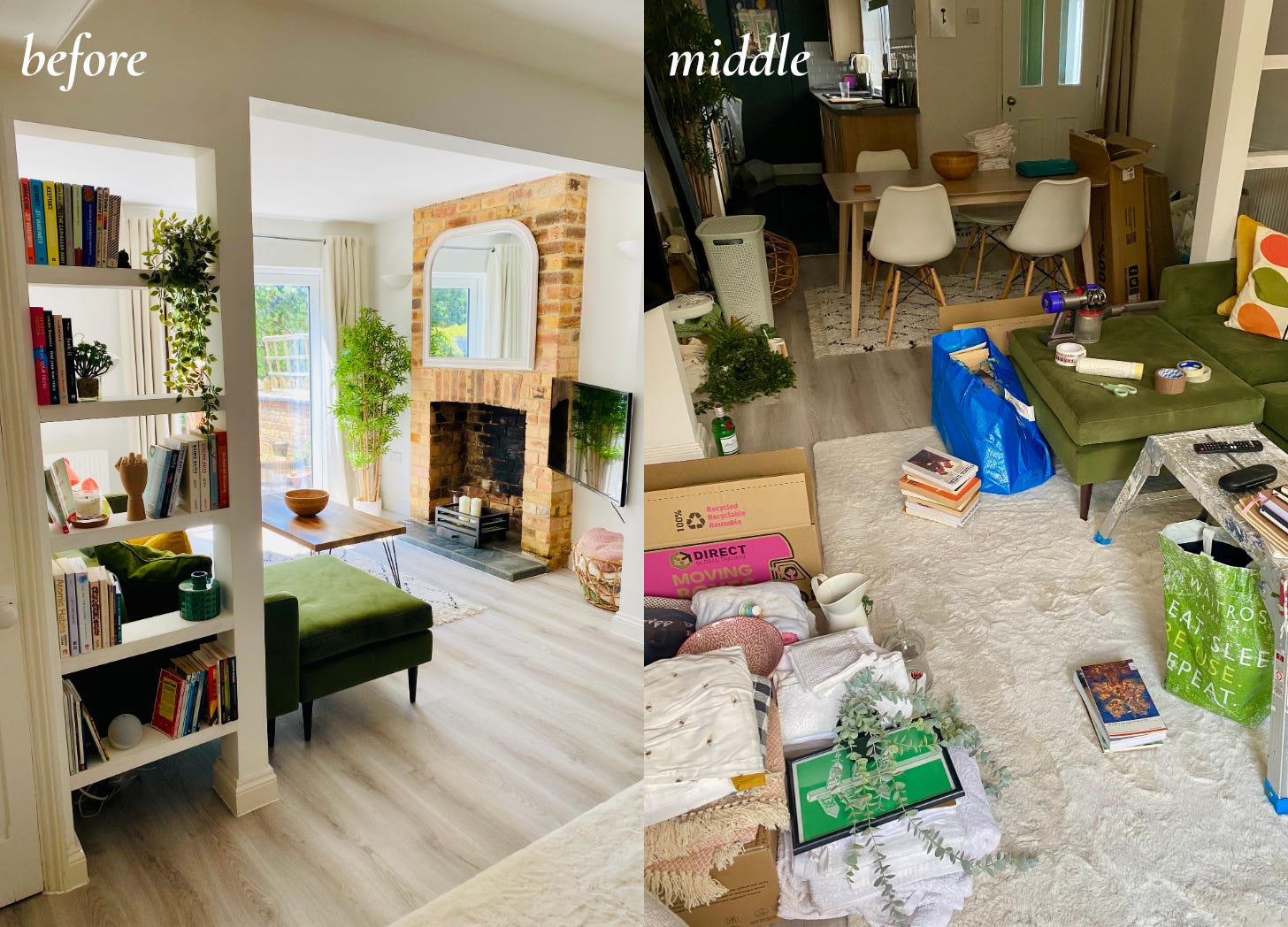
It will look worse before it gets better. Clearing out clutter creates temporary chaos. That’s normal. Push through the disorder and keep the end vision in mind. The space you want only comes after you go through the messy middle.
Be ultra, ultra careful about what you bring/accept into your life moving forwards. Every new object is a choice. Ask yourself: does this truly serve me? Does it fit the life I actually live? Being intentional with what you allow into your space prevents the clutter from creeping back in. Tools like the wishlist feature in my Intentional Life OS can help—it gives you a structured way to pause, reflect, and decide whether something really belongs in your life before it even enters your home.
Do not let things linger in your purse, bag, or home if they have no place there. Unclaimed items, forgotten papers, and random objects have a way of multiplying. Make it a habit to return things to their proper place or let them go immediately.
As I write this from my “new” home, there’s still plenty to do. A load of boxes sit in the garage, sorted into things to sell (with a firm deadline: if they haven’t sold, they’ll be donated), plus there are still a couple of tip and charity runs to make.
But mostly, I cannot overstate the relief of finally marking this goal as complete.
I’m not sure I realised just how heavy juggling my time between two properties had felt—always living out of suitcases, never fully able to call either one home.
I feel incredibly grateful and humbled by the process.
It’s reminded me that decluttering isn’t just about stuff—it’s about creating space for the life you actually want to live.
And now, with a bit of order restored, I can finally breathe, settle in, and enjoy life feeling a little lighter.
If you enjoyed this post, upgrading to a paid subscription or buying me a virtual coffee is a lovely way to show your support.
Alternatively, you can simply hit ‘like’—that makes my day too! 🤍